Everyday Strategies for Better Sleep
Practical sleep habits — consistent timing, a calm bedroom and a wind-down routine — and when to talk to a professional.
Read article
Practical guidance on movement, sleep, stress, connection and building habits that last — plus a free weekly checklist.
Healthy habits can support overall wellbeing, but they don’t cure diseases or replace professional treatment. If you have a health condition, talk to your health care provider before making significant changes.
The Canadian 24-Hour Movement Guidelines for adults aged 18–64 recommend:
Some activity is better than none. Walking, cycling, dancing, gardening and active chores all count. Start where you are and build up gradually.
How to build a sustainable exercise routine
The guidelines recommend 7 to 9 hours of good-quality sleep for adults aged 18–64, with consistent bed and wake-up times. Helpful habits include:
Source: Canadian Society for Exercise Physiology. Canadian 24-Hour Movement Guidelines for Adults aged 18–64 years.; Public Health Agency of Canada. Are Canadian adults getting enough sleep? Infographic (2019).
Talk to a health professional if poor sleep affects your daily life or continues for weeks, or if you notice loud snoring or pauses in breathing during sleep.
Stress is a normal part of life. Everyday strategies can help:
Source: Health Canada. Taking care of your mental health (described video).

Emotional wellbeing is about how we feel, think and cope. Health Canada encourages talking openly about mental health and reaching out for support when you need it — from people you trust or from a health professional.
Wellness habits can support emotional wellbeing, but they don’t replace professional care. If low mood, worry or stress lasts for weeks, gets worse or makes daily life hard, please talk to a doctor, nurse practitioner or mental health professional.
Source: Health Canada. Taking care of your mental health (described video).; 988 Suicide Crisis Helpline (Canada). Call or text 988, 24 hours a day.
In crisis? Call or text 988 any time to reach the Suicide Crisis Helpline (Canada). In an emergency, call 911.
Habits form through repetition in a consistent situation. In a frequently cited study, the median time for participants to reach near-maximum automaticity for a new daily behaviour was 66 days — but it ranged from 18 to 254 days, and missing a day didn’t derail progress.
Source: Lally et al., European Journal of Social Psychology (2010)

Relationships matter for wellbeing. Health Canada suggests taking part in family or community activities to build meaningful connections, and the food guide encourages eating meals with others when you can.
Source: Health Canada. Taking care of your mental health (described video).; Health Canada. Healthy eating recommendations. Canada’s food guide.
A quick message, a chat with a neighbour or a shared walk can all help you feel more connected.
Goals work best when they’re specific, realistic and flexible. Compare:
| Vague | Specific and realistic |
|---|---|
| “Exercise more” | “Walk for 15 minutes after lunch on weekdays” |
| “Eat healthier” | “Add a vegetable to dinner four nights this week” |
| “Sleep better” | “Screens off and in bed by 10:30 on weeknights” |
Review your goals every few weeks. Adjust them to fit your life — progress, not perfection.
Goals about everyday actions (what you’ll do) are within your control and easier to track than outcome goals.
Tick off habits as you go. Add up to two of your own. No sign-up — use it on screen, print it, or download a blank copy.
| Habit | Mon | Tue | Wed | Thu | Fri | Sat | Sun |
|---|---|---|---|---|---|---|---|
| Drink water with each meal | |||||||
| Vegetables or fruit at most meals | |||||||
| 20+ minutes of activity | |||||||
| Strength activity (aim for 2 days) | |||||||
| Break up long periods of sitting | |||||||
| Wind down and keep a regular bedtime | |||||||
| Connect with someone | |||||||
No account needed. Your ticks are saved only in this browser on this device.
Practical sleep habits — consistent timing, a calm bedroom and a wind-down routine — and when to talk to a professional.
Read articleEveryday strategies for managing ordinary stress, plus clear guidance on when and where to reach out for support.
Read article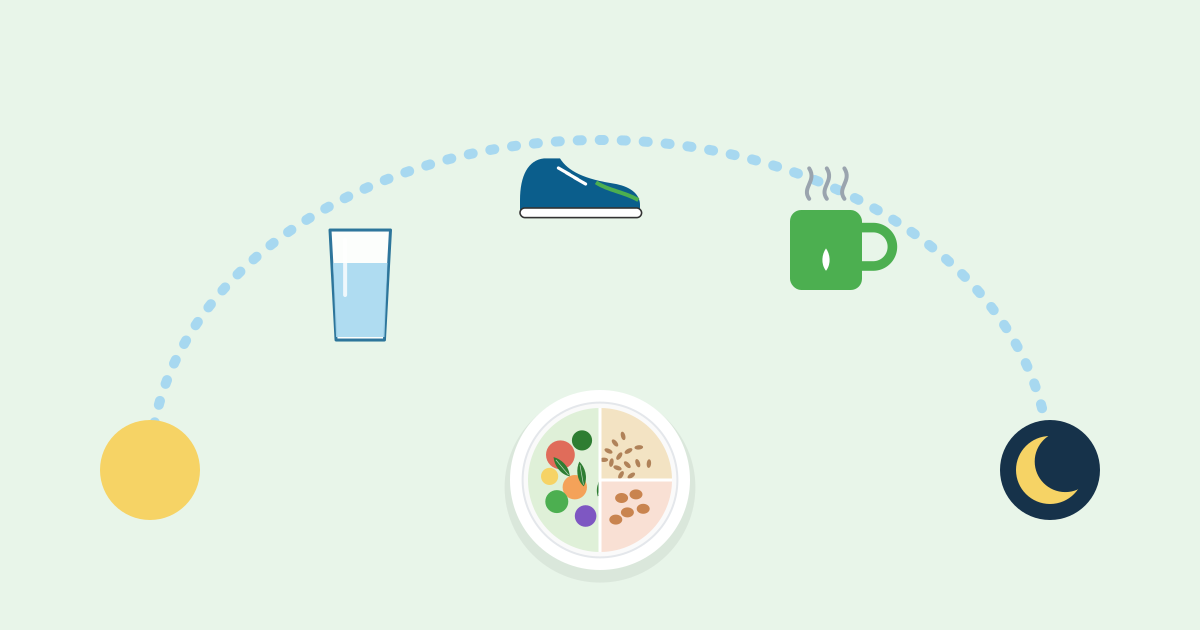
Bring food, movement, sleep and downtime together into a simple weekly routine that fits your life — and adjust it as you go.
Read articleFind practical, sourced articles on nutrition, fitness, sleep and stress.